
Summer Patio Project Planning in Iowa: Timeline, Materials & Costs
Summer is the busiest season for patio installation in the Cedar Valley, and for good reason. The ground is thawed and dry, construction conditions are optimal, and you get to enjoy the finished project for months before winter arrives. But summer also means competition for contractor schedules, potential rain delays, and a narrowing window before fall. Planning ahead makes the difference between a smooth project and a stressful one.
This guide covers everything Waterloo, Cedar Falls, and Cedar Valley homeowners need to know about planning a patio project this summer -- from realistic timelines and material choices to cost expectations and common mistakes to avoid.
The Summer Construction Window in Iowa
Iowa's practical outdoor construction season runs from mid-April through mid-November, but the sweet spot for patio work is May through September. Here is why timing matters:
- May-June: Ideal conditions. Soil is settled from spring thaw, temperatures are moderate, and contractor schedules are filling but not yet fully booked. This is the best window if you want your patio completed before the Fourth of July.
- July-August: Peak demand. Schedules are booked 4 to 8 weeks out. Heat can slow crew productivity, and afternoon thunderstorms cause periodic delays. Projects started in this window typically finish by early September.
- September-October: Excellent building weather with cooler temperatures, but the clock is ticking. Projects need to be completed before the first hard freeze, typically in late October or early November in the Cedar Valley.
If you are reading this in late May and have not contacted a contractor yet, you can still have a patio completed this summer -- but the earlier you start the consultation process, the more flexibility you have on scheduling.
Material Options for Iowa's Climate
Material selection is not just about appearance -- it is about how well the material handles Iowa's extreme temperature swings, which regularly range from 95 degrees in July to minus 20 degrees in January. That 115-degree annual temperature range means freeze-thaw durability is the single most important factor in material selection.
Interlocking Concrete Pavers
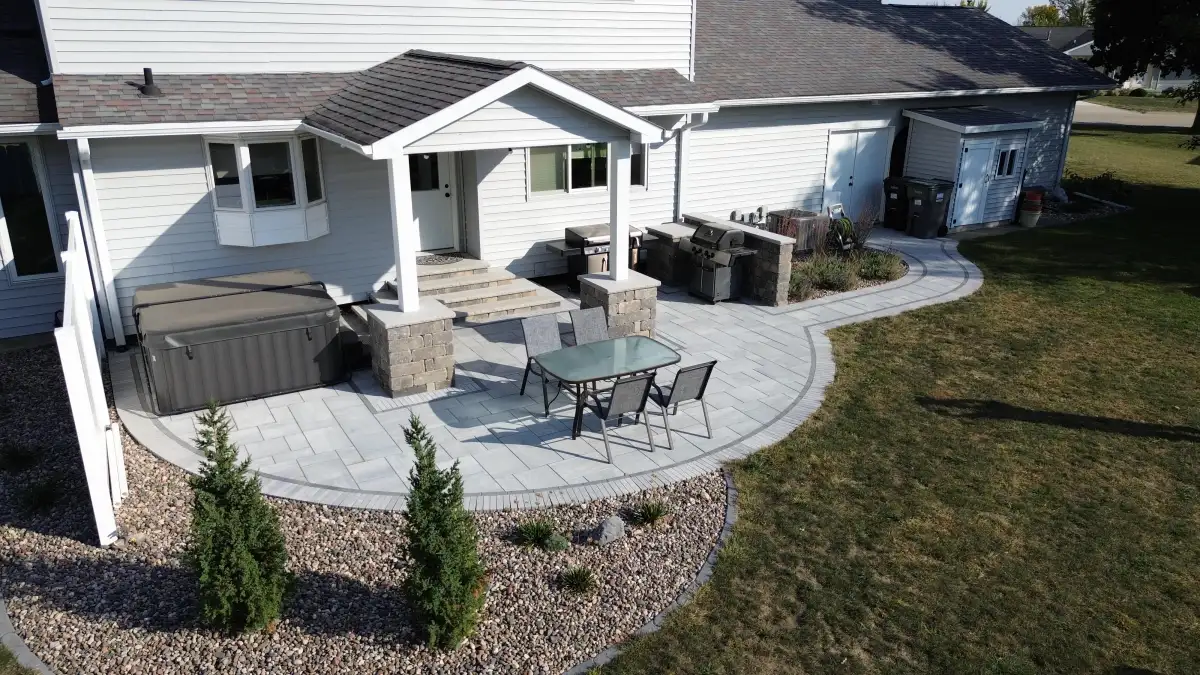
Concrete pavers are the most popular choice for residential patios in the Cedar Valley, and they earn that popularity. The interlocking design allows the surface to flex with seasonal ground movement instead of cracking. Individual pavers can be pulled and replaced if one is damaged. Modern pavers come in hundreds of colors, shapes, and textures -- from clean contemporary lines to tumbled stone looks that mimic natural flagstone.
Concrete pavers are rated for compressive strength (typically 8,000+ PSI) and absorption resistance (less than 5%), both of which matter in freeze-thaw climates. They handle Iowa winters without the spalling and surface deterioration that affects poured concrete.
Natural Stone
Bluestone, limestone, and flagstone patios offer a distinctive look that concrete cannot replicate. Natural stone is exceptionally durable, ages beautifully, and adds a premium feel to any outdoor space. The tradeoff is cost -- natural stone typically runs 30 to 50 percent more than comparable paver installations -- and the installation process requires more precision in base preparation and joint work.
For Iowa properties, limestone is a practical choice because it is locally quarried (reducing material cost), naturally slip-resistant when wet, and handles freeze-thaw cycles well. Bluestone imported from the East Coast is popular for its consistent color and flat surface, but transportation costs add to the per-square-foot price.
Poured Concrete
Stamped or brushed concrete patios offer the lowest installed cost per square foot but come with limitations in Iowa's climate. Poured concrete is rigid -- it cracks when the ground shifts, which happens every spring in the Cedar Valley as frost heaves settle. Stamped concrete requires resealing every 2 to 3 years to maintain its appearance, and crack repair is always visible.
We generally recommend poured concrete only for utility areas (pad for an AC unit, garbage can pad) rather than primary entertainment patios. For spaces where appearance and longevity matter, pavers or natural stone are better long-term investments.
Base Preparation: Why It Matters More Than the Surface
Iowa's soil conditions -- predominantly clay in the Cedar Valley -- make base preparation the most critical phase of any hardscaping project. Clay holds water, expands when wet, contracts when dry, and heaves when frozen. A patio installed on improperly prepared clay soil will shift, settle, and develop drainage problems within one to two winters.
Proper base preparation for a Cedar Valley patio includes:
- Excavation: Remove 8 to 12 inches of native soil below finished grade. The depth depends on soil type and drainage conditions at your specific site.
- Geotextile fabric: A separation layer prevents clay subsoil from migrating up into the gravel base over time. This single step prevents the most common cause of patio failure in our region.
- Compacted gravel base: 6 to 8 inches of crushed limestone, compacted in 2-inch lifts. Each lift must be mechanically compacted to 95% Proctor density. This is not a step you shortcut -- every inch of base that is not properly compacted shows up as settling within the first year.
- Bedding layer: 1 inch of concrete sand, screeded to precise grade. This layer provides the final leveling surface for paver placement.
- Edge restraint: Aluminum or composite edge restraint anchored with 12-inch spikes prevents lateral movement of the paver field. Without proper edge restraint, pavers migrate outward over time, opening joints and allowing weed growth.
The base represents roughly 60 percent of the labor in a patio installation. Companies that cut corners on base preparation offer lower bids but deliver patios that fail within a few years. Ask any contractor how deep they excavate, how many inches of base they install, and whether they use geotextile fabric. If any answer is vague, keep looking.
Design Considerations for Iowa Outdoor Living
Size and Layout
A common mistake is building a patio that is too small. A standard outdoor dining set (table and 6 chairs) needs a minimum 12x14-foot area, and that leaves no room for traffic flow. Add a grill or outdoor living zone and you are looking at 300 to 500 square feet as a practical minimum for a patio you will actually use.
Think about how you entertain. If you host large gatherings, plan for 25 to 30 square feet per person in the seating area. If your patio primarily serves a family of four, 200 to 250 square feet may be sufficient.
Grade and Drainage
Every patio must pitch away from the house at a minimum slope of 1/4 inch per foot. In the Cedar Valley, where summer thunderstorms can drop 2 or more inches of rain in an hour, proper drainage prevents water from pooling on the patio surface or, worse, running back toward your foundation. If your yard slopes toward the house, you may need a retaining wall or drainage system incorporated into the patio design.
Access to Utilities
If you plan to add landscape lighting, a fire pit, an outdoor kitchen, or speakers in the future, run conduit and gas lines during the patio construction phase. Trenching through a finished patio to add a gas line two years later is expensive and disruptive. Even if you are not adding those features now, installing empty conduit during construction costs a fraction of what it would cost to add later.
Cost Expectations in the Cedar Valley
Patio installation costs in Waterloo and Cedar Falls depend on material choice, project size, base conditions, and design complexity. Here are realistic ranges for 2026:
- Standard paver patio: $18 to $28 per square foot installed, including excavation, base, and edge restraint.
- Premium paver patio (large format, textured, or Belgard/Unilock brands): $25 to $38 per square foot.
- Natural stone patio: $30 to $50 per square foot depending on stone type and sourcing.
- Add-ons: Seating walls ($75-$125 per linear foot), fire pit ($2,500-$6,000), step systems ($150-$300 per step).
For a typical 300-square-foot paver patio with a small seating wall, Cedar Valley homeowners should budget $6,000 to $10,000. Larger projects with multiple levels, fire pits, and integrated lighting range from $15,000 to $30,000 or more.
Common Mistakes to Avoid
Choosing a Contractor Based Only on Price
The lowest bid almost always means shortcuts on base preparation, cheaper materials, or inexperienced crews. A patio that costs $4,000 less upfront but needs $3,000 in repairs after two winters is not a bargain. Ask for references, look at completed projects that have been through at least one Iowa winter, and compare what is included in each bid -- not just the total number.
Ignoring the Surroundings
A patio does not exist in isolation. Consider how it connects to the house, the yard, and any existing landscape features. A well-designed patio includes transition areas, pathways, and plantings that make the space feel intentional rather than dropped onto the lawn.
Skipping Permits
Most standard patios in the Cedar Valley do not require permits, but projects that involve retaining walls over 4 feet, changes to grade that affect drainage to neighboring properties, or structures with roofs (pergolas, covered patios) typically do. Check with your local building department before construction starts.
Frequently Asked Questions
How long does a patio installation take in Iowa?
A standard paver patio (200 to 400 square feet) takes 3 to 5 days from excavation to completion. Larger projects with retaining walls, fire pits, or multi-level designs may take 2 to 3 weeks. Weather delays can add 1 to 3 days during Iowa's summer storm season.
What is the best patio material for Iowa weather?
Interlocking concrete pavers are the most durable option for Iowa's freeze-thaw climate. They flex with ground movement instead of cracking, require no sealing in most cases, and individual pavers can be replaced if damaged. Natural stone (bluestone, limestone) is also excellent but costs more and requires careful base preparation.
How much does a patio cost in the Cedar Valley?
In the Waterloo and Cedar Falls area, expect $18 to $28 per square foot for a standard paver patio with proper base preparation. A 300-square-foot patio runs roughly $5,400 to $8,400. Adding retaining walls, fire pits, seating walls, or built-in lighting increases the total depending on scope.
Ready to Start Your Patio Project?
Matthias Landscaping has been building patios, retaining walls, and outdoor living spaces across the Cedar Valley since 1991. We handle every phase in-house -- design, excavation, base preparation, paver installation, and finishing -- with crews that understand Iowa's soil and climate conditions.
Schedule a free consultation or call (319) 226-6000 to discuss your project. We serve homeowners in Waterloo, Cedar Falls, Waverly, Hudson, Independence, and throughout Black Hawk County.